
The Grid Has a Capacity Problem.
The Solution May Start with the Structures Already in Service.
The US Federal Energy Regulatory Commission (FERC) and the US Department of Energy (DOE) are pushing faster large-load interconnection and existing-ROW upgrades. Many corridors hit limits before the conductor does.
Here is how to find the bottleneck.
Summary:
- Demand growth is forcing faster answers. FERC’s June 2026 show-cause orders to all six RTOs and ISOs, along with DOE’s approximately $1.9 billion SPARK funding opportunity, both point toward faster use and upgrading of existing assets.
- Conductor rating is rarely the only constraint. Clearance, tower strength, corrosion, foundation condition, access, and outage availability can determine whether a project moves forward.
- A useful upgrade plan walks the whole corridor and matches the construction method to the actual bottleneck.
- GETs and DLR can reveal headroom, but the corridor still has to physically support the intended loading, sag profile, and reliability requirements.
- Energized structural work, foundation and corrosion mitigation, and existing-ROW upgrades can help move projects from paper to in-service capacity.
The pain: a corridor is more than a conductor
Most capacity conversations start with the wire, which makes sense, because the conductor is what people see and what many rating studies print first.
However, a transmission corridor is a full system: tower geometry, conductor sag and clearance, foundation capacity, steel condition, access, and an outage window the control room will actually grant. When demand steps up and someone says, “We need more capacity on this line,” the binding constraint may be somewhere other than the wire.
The conductor might be adequate. The tower might be the limit. Or the clearance. Or the foundation that was sized for a different load case. Or the access road that does not exist.
Utilities, developers, and large-load customers are all feeling this at once. On June 18, 2026, FERC issued show-cause orders directing all six RTOs and ISOs under its jurisdiction, along with their transmission owners, to justify or reform rules governing how data centers, manufacturing facilities, and other large energy users connect to the grid.
The orders address study processes, cost transparency, co-location, flexible large-load service, and generation serving large loads. DOE’s SPARK funding opportunity, issued on March 12, 2026, offers approximately $1.9 billion for grid resilience, advanced transmission technologies, and large-scale upgrades. DOE specifically identifies projects that use existing rights-of-way among its priorities.
The direction is clear. More demand and more regulatory urgency are arriving at the same time as a stronger focus on existing assets. That makes the question practical, not academic:
What is actually limiting each corridor, and which construction method matches that limit?
Why corridor constraints are becoming more important
There are 3 forces converging.
1️⃣ Large loads are getting their own regulatory lane
FERC’s June 2026 orders direct every jurisdictional RTO and ISO to address study processes, cost shifts, co-location, and flexible service for data centers, manufacturing, and other large energy users.
For utilities, that translates into real study timelines and pressure to identify capacity on assets that already exist. For developers and large-load customers, it makes the physical condition of the connecting corridor part of the schedule conversation.
2️⃣ Funding is following existing rights-of-way
DOE’s SPARK funding opportunity names three priority areas: reconductoring with advanced conductors, advanced transmission technologies that increase usable capacity of existing assets in real time, and large-scale cross-regional upgrades.
The stated focus is on making better use of existing infrastructure while longer-term transmission expansion continues. That makes the condition and adaptability of existing corridors more important during early project screening.
3️⃣ Digital capacity still needs a physical corridor
EPRI’s GET SET initiative covers four high-impact technologies: Dynamic Line Ratings, Advanced Conductors, Advanced Power Flow Control, and Topology Optimization.
These tools can reveal or route additional headroom. They do not remove the need to confirm that the towers, foundations, clearances, and access plan can support the intended outcome.
EPRI’s technical material also makes an important point about Dynamic Line Ratings. Ratings depend on conditions such as wind, temperature, terrain, and line geometry. They can vary by span and circuit, carry measurement uncertainty, and require risk controls.
The software can improve the picture. The physical corridor still determines what can safely be built and operated.
How to diagnose the actual bottleneck
Before selecting an upgrade, walk the corridor and pressure-test each constraint. A practical screen covers at least:
- Conductor rating: What is the current rating, and what conductor and operating temperature are planned under the upgrade?
- Sag and clearance: Will the proposed operating conditions maintain the required clearances to ground, underbuild, and adjacent phases?
- Tower strength: Can the existing structure carry the new loading, including any change in conductor, tension, or circuit configuration?
- Foundation condition: Are uplift, bearing, and overturning capacities adequate under the new loading? Are there signs of concrete degradation, anchor corrosion, or scour?
- Steel condition: What do galvanizing, member section loss, cracked welds, and bolted connections say about the structure’s remaining capacity?
- Access and outage window: Can crews and equipment reach the site, and can the system spare the line for the duration the work requires?
In practice, several of these constraints can bind at once. That is why the corridor, rather than the wire alone, should be the unit of analysis.
Why the conductor is only one part of the project
Reconductoring receives significant attention because a higher-capacity conductor on an existing line can be part of a major capacity upgrade. It is also only one part of the engineering problem.
A changed conductor can alter thermal, sag, and mechanical loading conditions. Sag can reduce clearance. Higher tension can affect the structure and foundation. A heavier conductor can change stringing equipment and pulling plans.
The project that looked like a conductor change during early planning can become a structural, foundation, clearance, and outage project by the time it reaches construction.
The useful framing is conductor-agnostic. Start with the required capacity, then ask what the corridor can support.
If the binding constraint is clearance, raising the tower may be an option. If the binding constraint is structure strength, reinforcement or an existing-ROW structural solution may be appropriate. If the binding constraint is foundation capacity, foundation work needs to be part of the plan. If corrosion has reduced the available capacity, inspection and repair may need to happen before the next upgrade.
Ampjack does not replace conductors. Ampjack supports the structural work that capacity-upgrade projects may require, including tower raising, reinforcement, clearance correction, foundation work, corrosion mitigation, and energized construction planning.
How Ampjack helps the structures already in service
Ampjack works on the structural and physical-enablement side of the corridor. Several capability areas apply to existing-ROW projects.
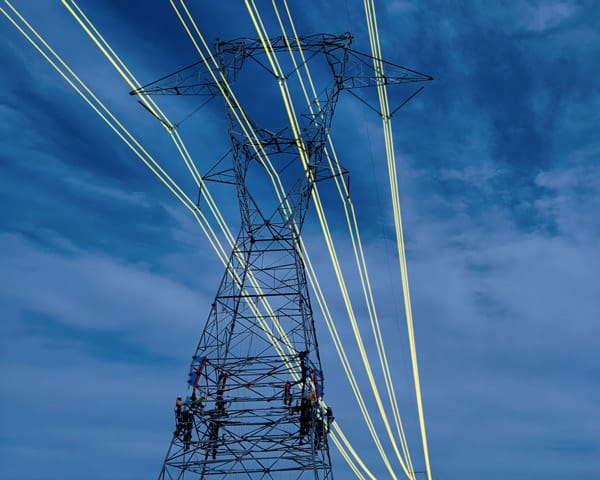
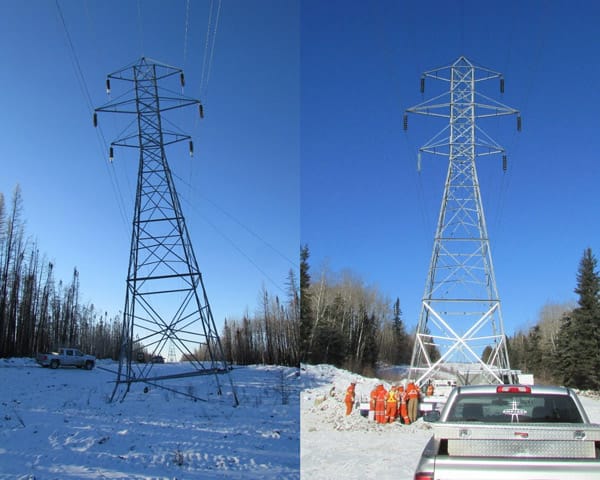
AMPJACK® energized tower raising
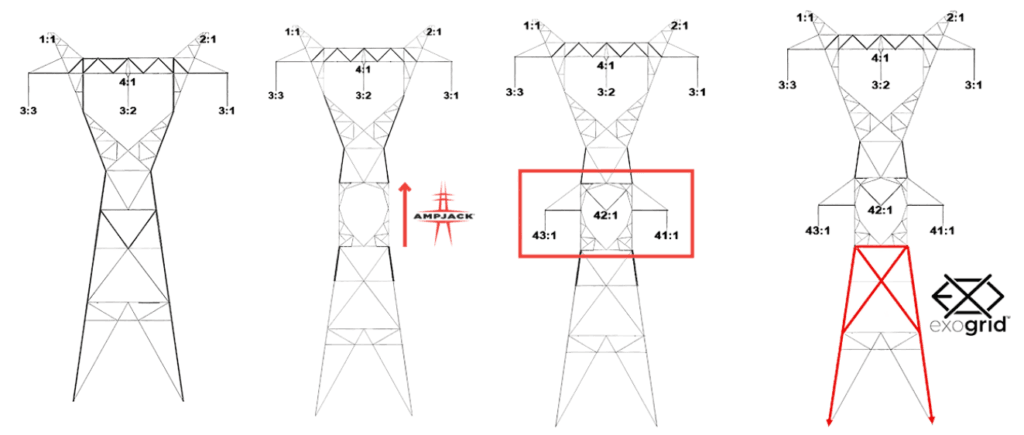
Ampjack’s patented system raises existing transmission towers while the line remains energized. The hydraulic system mounts inside the tower body, takes the load of the section and conductor, and lifts to the specified height before new framing is bolted in and the system is removed.
The system is designed to avoid cranes and heavy suspended loads for the tower-raising work. It packs into approximately 8 to 12 job boxes and is heli-lift capable, which matters on corridors without road access or crane pads.
Depending on project conditions, energized work can reduce the need for an outage and the associated contingency planning and scheduling burden. The project still requires engineering review, operating coordination, and a site-specific safety plan.
Structural repair and reinforcement
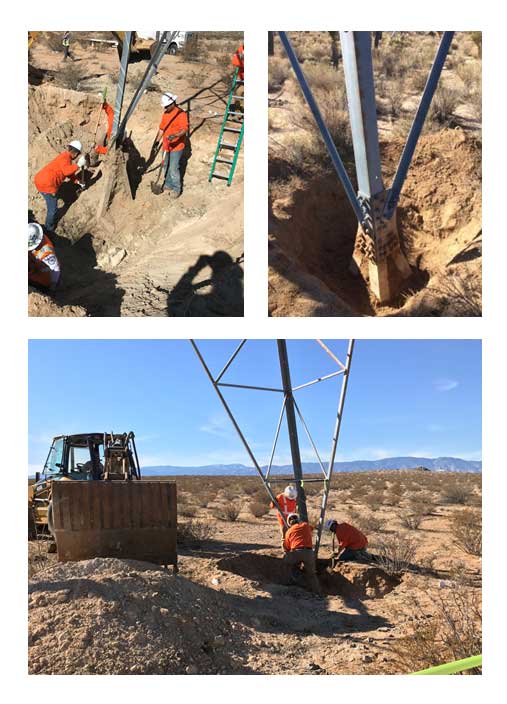
The same controlled lifting principle can support work on individual tower legs and structural members. That can include foundation rebuilds, concrete work, anode installation, and other repairs to existing structures.
A small specialized crew and standard trucks can keep mobilization light on remote or environmentally sensitive lines, subject to the project scope and site conditions.
Corrosion mitigation
Ampjack’s corrosion services include inspection, NDT, coatings, cathodic protection, risk mapping, and remaining-life assessment.
The objective is to understand the condition of steel already in service and select an appropriate repair or life-extension path. That work has to fit the line’s outage, access, loading, and construction realities.

Foundation work
Foundations are assessed for uplift, bearing, and overturning capacity under the raised or reinforced loading. Where capacity is short, foundation mitigation can be incorporated into the project plan.
Combining foundation work with tower raising or structural reinforcement keeps the load path consistent from engineering through construction.
exogrid™ existing-ROW upgrades
exogrid™ is a patented exoskeleton approach that adds structural steel around existing towers to support capacity upgrades and grid hardening on the existing right-of-way.
Potential applications include converting tangent structures to dead ends, rerating towers for higher wind loads, and accommodating larger conductors at higher tensions. Each application requires line analysis, phase-configuration studies, foundation analysis, conductor selection, and construction planning.
exogrid™ can also be licensed to qualified utilities, engineering firms, and EPCs. It is a project-specific structural approach, not a blanket promise of reduced cost, permitting, or schedule.
Ampjack’s role in reconductoring-adjacent work is to help make sure the structure, foundation, clearance, and construction plan support the intended conductor change.
Practical screening checklist
Before committing to a corridor-upgrade path, a short screen can identify problems early:
- What is the binding constraint? Conductor, clearance, tower, foundation, corrosion, access, or outage window?
- Can the structure be modified in place? If so, tower raising, repair, reinforcement, or exogrid™ may warrant comparison with replacement.
- Can the foundation take the new loading? If not, plan foundation work before the conductor change reaches construction.
- What is the corrosion baseline? Inspection, NDT, and remaining-life assessment set the floor for structural decisions.
- What is the realistic outage window? If it is short or unavailable, energized construction methods may change the project plan.
- What is the access story? Modular equipment and heli-lift capability can affect the feasibility of remote work.
- Which pieces can run in parallel? Structural work, foundation work, and corrosion mitigation may be sequenced together, with conductor work coordinated around the completed physical scope.
Conclusion
The grid’s capacity problem is real, and it will not be solved by a single technology.
FERC is reshaping how large loads connect. DOE is funding upgrades that make use of existing rights-of-way. GETs are revealing headroom on assets already in service.
The corridor still has to physically carry the new loading.
Treat the corridor as the unit of analysis. Diagnose the actual bottleneck. Match the construction method to the constraint. Use energized work where project conditions allow it. Repair, reinforce, and harden what is already standing before defaulting to replacement.
If you are scoping a corridor upgrade and want a second set of eyes on what is limiting your line, contact Ampjack.